
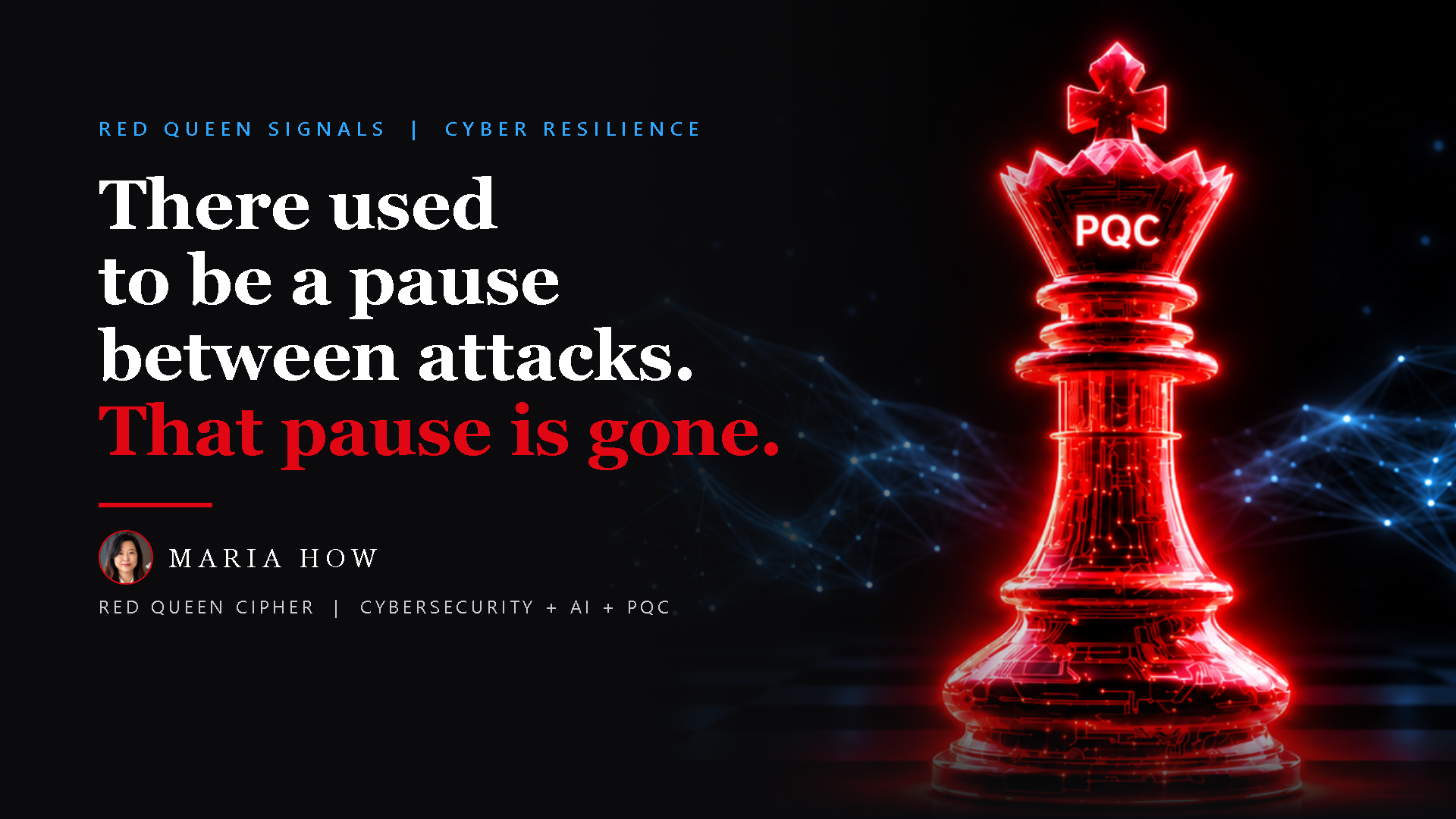
There Used to Be a Pause Between Attacks. That Pause Is Gone.
Patch cycles, alert queues and recovery plans were all timed to an attacker who had to stop and think. AI-driven attackers do not stop. Here is what resilience looks like when the breathing room is gone.
 By Maria How | Published November 15, 2026 | 7 min read
Executive takeaway
- What happened: Google Project Zero says zero patch-to-exploitation time is now a reasonable model of attacker behavior, and it is dropping patch soak time from its disclosure policy.[1]
- What it means: Every security timeline built on the attacker's pause, from monthly patch cycles to quiet-day recovery, is now a gap. Resilience means controls that work with no breathing room.analysisanalysis
- The decision: Set an hours-based target for closing known-exploited flaws on internet-facing systems, and report exposure hours to the board. Restore nothing after an incident until every reachable credential is rotated.analysisanalysis
The briefing, spoken version
Transcript: The pause is gone
This is Red Queen Signals, the audio briefing from Red Queen Cipher. I'm Maria How.
Today, the security control that nobody ever wrote down.
Think about how a security team runs. A patch comes out, and you schedule it for the next maintenance window. An alert fires overnight, and someone looks at it in the morning. You clean up an intrusion, the logs go quiet for a day, and you bring the systems back.
Every one of those habits rests on the same assumption. That the attacker pauses. That they need time to work out the patch, time to decide what a stolen password opens, time to regroup after you kick them out.
Here's my position. That pause is gone. And every timeline we built on it is now a gap.
Let me take you through three places it disappeared, all in the last couple of weeks.
The first pause was before the attack. The gap between a fix being published and someone exploiting it.
On the thirteenth of November, Google's Project Zero changed its disclosure policy. That's the team that finds some of the most serious bugs in the world. And here's what they wrote. Quote. Zero patch-to-exploitation time is a reasonable, though imperfect, model of attacker behavior. End quote. They say AI has made attackers that much faster at turning a patch into an exploit. So they dropped the extra time they used to allow for patches to roll out.
They also said this. They're now finding several vulnerabilities a week in targets where they once found a few a year. And their deadline for vendors drops from ninety days to sixty in February twenty twenty-seven, and to thirty in January twenty twenty-eight.
Mandiant, looking at its 2025 investigations, already estimated the average time to exploit at minus seven days. Minus. Attacks starting before the patch exists. Now, to be fair, nobody has measured how much of that is AI and how much is everything else. I'm not going to make up a number. But the direction is clear.
The second pause was during the attack.
A human intruder who finds a password has to stop and think about it. What is this? What does it open? Is it worth the risk? That moment of hesitation is where defenders used to catch people.
An incident response firm called Eye Security described a case this week at a European online retailer. And they put it perfectly. Quote. A human threat actor who finds a password has to stop, read, decide and try. These agents did not. End quote.
Same week, the security company Barracuda published an account of an intrusion into its own cloud. The attacker used an access key that Barracuda had given a third-party vendor and never switched off. In about forty-four hours, it touched around ten cloud accounts. By the time an engineer noticed something odd, on the fourth of November, the attacker had already finished.
Barracuda's security chief drew the lesson. Defenders who wait to spot an attack and then respond will often arrive after the attacker has finished. His answer is to focus on prevention and recovery. And he says short-lived, narrowly scoped credentials would have stopped it at the very first step.
The third pause is the one that worries me most. After the attack.
Back to the Eye Security case. The defenders worked through a whole day with no alerts. They replaced the passwords they knew about. Everyone agreed to bring the systems back online. And, quote, less than an hour later, the threat actor was back with critical alerts. End quote.
Their explanation? The quiet spell was most likely just a gap in the attacker's resources. The attacker still had a way into the company's source code.
So that quiet day wasn't a pause. It was the attacker waiting.
Which brings me to the Red Queen. In Through the Looking-Glass, she tells Alice it takes all the running you can do just to stay in the same place. In 1973, the biologist Leigh Van Valen borrowed her name for an idea in evolution. The struggle for existence never eases up, so nobody pulls ahead for long.
Here's the bit people miss. It doesn't say the fastest wins. It says nobody gets to rest. Resilience now means building something that keeps running without the breather.
So, four decisions for leaders. These are my recommendations, not legal obligations.
One. Measure exposure in hours, not patch cycles. For anything facing the internet, set a target in hours for fixing or shielding flaws that are known to be exploited.
Two. Retire long-lived keys. Start with the ones held by vendors and AI tools.
Three. Rotate before you restore. Nothing comes back online until every password and key the intruder could have reached has been changed, and the old ones no longer work.
Four. Put the new clock into your supplier contracts.
And one measure for the board. Exposure hours. How many hours a known, exploited flaw stayed open on a system facing the internet. My prediction: by twenty twenty-eight, a monthly patch cycle for those systems will be very hard to defend.
One caveat. Those two intrusion stories come from the defenders themselves, and they're two incidents. They illustrate the point. They don't prove a trend.
But none of that brings the pause back.
The full analysis, with every source, is on redqueencipher dot com. I'm Maria How. Keep running.
The control nobody wrote down
Almost every security program relies on a control that appears in no policy, no framework and no audit report. It is the pause.
The pause between a patch shipping and someone working out how to exploit it. The pause between an attacker finding a password and deciding what to do with it. The pause after you evict an intruder, when the logs go quiet and everyone gets some sleep.
We built our timelines around it. Monthly patch cycles. Alert queues triaged in the morning. Recovery plans that restore service after a quiet day. All of them quietly assumed an attacker who had to stop and think.
Here is my position. That pause is gone, and every timeline built on it is now a gap. AI has removed the breathing room before the intrusion, during it and after it. Resilience now means controls that work with no pause at all.analysis
Before the intrusion: patch to exploit is now zero
On November 13, Google Project Zero changed the disclosure policy it has run since 2021. Its reasoning is the clearest statement of the new tempo I have read from people who find vulnerabilities for a living.
"LLMs have increased the speed at which attackers can find and exploit vulnerabilities," the team writes. AI has also shortened the time it takes to reverse engineer a patch, "to the extent that zero patch-to-exploitation time is a reasonable, though imperfect, model of attacker behavior." Its conclusion: "Patch soak time is no longer meaningful."[1]
Read that again as a board member. The window between a fix being published and an attacker using what the fix reveals is now modeled as zero by one of the most respected research teams in the industry.
Project Zero's own output tells the same story. "We are finding several vulnerabilities a week in targets where we once found a few vulnerabilities a year."[1] So it is tightening its clock. Disclosure now comes 90 days after a report, with no extra 30 days for patch rollout. That drops to 60 days on February 2, 2027, and 30 days on January 3, 2028. "It is crucial that vendors move towards remediating vulnerabilities faster."[1]
The wider data points the same way. Mandiant's M-Trends 2026, drawn from more than 500,000 hours of investigations in 2025, estimates the mean time to exploit at -7 days. Exploitation is routinely starting before a patch exists.[4] CISA said it plainly in June when it ordered federal agencies to fix the highest-risk flaws within three days: threat actors' "use of AI may further narrow the time defenders have to react between patch release and possible exploitation."[5]
One honest caveat. Nobody has measured how much of this speed-up is AI and how much is everything else. Mandiant's numbers cover 2025 and do not single out AI. I am not going to invent a share. The direction is what matters, and it is not in dispute.
During the intrusion: the attacker no longer stops to think
The second pause lived inside the attack. A human intruder who finds a credential has to read what it is, guess what it opens and decide whether to risk it. That hesitation was where defenders caught people.
This week, Eye Security published a case from a European e-commerce company. Its researchers put the difference better than I can: "A human threat actor who finds a password has to stop, read, decide and try. These agents did not." They describe "an army of autonomous AI agents" in which "each new secret was put to work immediately." When a responder deleted the attacker's workloads, the deployment automation "re-created them within a second."[3][3]
Barracuda's CISO, Arve Kjoelen, published his own company's account on November 11. An attacker used a cloud access key Barracuda had given a third-party vendor and never retired. It made its first call at 04:33 on November 1. "In all, the attacker touched about 10 cloud accounts in roughly 44 hours." Barracuda describes the tooling, ARTEX, as an "AI-driven penetration-testing framework." The attacker "had finished its run in less than two days." An engineer reported unusual activity on November 4.[2]
Two days after it was over.
Kjoelen's conclusion is the one I want every leadership team to hear: defenders who rely on spotting malicious activity and then responding "will often arrive after the attacker has finished." His answer: "The focus must move to prevent and recover." And: "Short-lived, narrowly scoped credentials would have stopped this intrusion at its first step."[2]
Credit to both companies. Publishing your own incident in this much detail is uncomfortable, and it is exactly how the rest of us learn.
After the intrusion: the quiet day was not a pause
The third pause is the one I find most dangerous, because it feels like victory.
In the Eye Security case, defenders worked for a day with no alerts. The known secrets were replaced. Everyone agreed to bring systems back online. "Less than an hour later, the threat actor was back with critical alerts."[3]
Eye Security's explanation: "The pause was most likely a gap in the threat actor's resources," and the attacker "still held access to source control." Their lesson for responders is one sentence I would put on every recovery runbook: "Rotating a credential is not finished when it is changed." It is finished when the old one is rejected everywhere.[3]
The quiet you see after an eviction may just be the attacker waiting for compute. Restore on the strength of a quiet day and you are restoring on the attacker's schedule.
The Red Queen was never about speed
In Through the Looking-Glass, the Red Queen tells Alice that "it takes all the running you can do, to keep in the same place." In 1973 the biologist Leigh Van Valen borrowed her name for the Red Queen hypothesis: "the struggle for existence never eases up, so that no species or lineage ever pulls ahead for long."[6, 7]
Notice what that hypothesis does not say. It does not say the fastest species wins. It says nobody gets to rest. The race is continuous.
Security has spent decades treating defense as a series of sprints with rests in between. Patch Tuesday, then recovery. Incident, then lessons learned. The rests were the pause. Without them, resilience is not about running faster in bursts. It is about building a system that keeps running when nobody is watching.analysis
What leaders should decide now
These are my recommendations, not legal obligations.analysis
Measure exposure in hours, not patch cycles. For internet-facing systems, set a target for closing or shielding known-exploited flaws measured in hours. CISA's three-day timeline binds federal agencies only, but it is a useful benchmark for your own risk appetite. If a fix takes longer, decide in advance what shields the system: taking it offline, a virtual patch or a block at the edge.
Remove what the attacker needs before they need it. Retire long-lived keys, starting with the ones held by vendors and AI tools. Barracuda's intrusion began with a key from a previous project that nobody had retired. Short-lived, narrowly scoped credentials would have stopped it.
Automate containment, and name the human who decides. If your first response depends on an analyst reading an alert in the morning, the attacker has finished by then. Pre-approve the containment actions that can run at machine speed, and name who can authorize the bigger ones at 3 a.m.
Rotate before you restore. No system comes back online until every credential the intruder could have reached is rotated, the old ones are rejected, and source control and deployment pipelines have been checked. Treat a quiet day as a question, not an answer.
Put the new clock in your contracts. Project Zero's disclosure deadlines will be 30 days by January 2028. Ask your key suppliers how fast they ship fixes for exploited flaws, and write it into renewals.
The measure I would take to the board
Exposure hours: for internet-facing systems, the hours between a known-exploited flaw becoming public and it being fixed or shielded. Report it every quarter next to your other cyber risk measures. It turns "are we patched?" into "how long were we open?"analysis
Here is my forecast. Once disclosure deadlines reach 30 days in January 2028, a monthly patch cycle for internet-facing systems will be very hard to defend to a board, a regulator or an insurer.analysis
What would change my mind
If AI-driven attacks prove noisy and easy to block at scale, the case for prevention over detection would weaken. The two intrusion accounts here come from the defenders themselves and describe two incidents. They illustrate the argument and do not measure a trend. And Mandiant's numbers do not single out AI as the cause.
None of that brings the pause back.
Keep running
The pause was never ours. It was a limitation of the attacker, and we treated it as a feature of our defense. The organizations that come through this well will be the ones that stop waiting for the breather and build for the race that does not stop.
Keep running.
Evidence and method
Every material claim in this article maps to this register. "First-party reported" means the organization involved said it. It does not mean it was independently verified.
| Claim | Evidence | Limits |
|---|---|---|
| The pause was an unwritten security control. Monthly patch cycles, alert queues reviewed in the morning, and recovery after a quiet day were all timed to an attacker who had to stop and think. AI has removed the pause before, during and after the intrusion. | Maria's analysis | Analysis built on Project Zero's model, Mandiant's 2025 data and two first-hand incident accounts. It describes a direction, not a measured change in every organization. |
| Resilience without the pause means removing what an attacker needs before they need it (exposure closed in hours, credentials that expire), and recovering as if the attacker will return immediately. Detecting faster is necessary but no longer enough. | Maria's analysis | Analysis. Detection still matters; the argument is about what to fund first, not about switching detection off. |
| The recommended actions (an hours-based target for internet-facing known-exploited flaws, retiring long-lived and third-party keys, automated containment with a named human decision-maker, rotate-before-restore recovery, and patch and disclosure terms in supplier contracts) are Maria's recommendations, not legal obligations. | Maria's analysis | Recommendations. CISA's three-day timeline applies to US federal agencies only and is used as a reference point, not a requirement. |
| Forecast: once Project Zero reaches 30-day disclosure in January 2028, a monthly patch cycle for internet-facing systems will be hard to defend to a board, a regulator or an insurer. | Maria's analysis | Maria's forecast. Regulators and insurers have not said this. |
| Leaders should report exposure hours to the board: for internet-facing systems, the hours between a known-exploited flaw becoming public and it being fixed or shielded. | Maria's analysis | A proposed measure, not an established industry metric or a legal obligation. |
| On November 13, 2026, Google Project Zero said LLMs have increased the speed at which attackers find and exploit vulnerabilities and have cut the time to reverse engineer a patch, to the extent that zero patch-to-exploitation time is a reasonable, though imperfect, model of attacker behavior. It said patch soak time is no longer meaningful. | First-party reported Source 1 | Project Zero's own assessment, stated as a model, and Project Zero itself calls it imperfect. It is not a measurement of every exploit. |
| Project Zero says it is now finding several vulnerabilities a week in targets where it once found a few a year. | First-party reported Source 1 | Self-reported by Project Zero about its own work. The targets are not listed in the passage. |
| Project Zero has replaced its 90 + 30 policy, in place since 2021, with disclosure 90 days after a report, moving to 60 days on February 2, 2027 and 30 days on January 3, 2028, and says vendors must remediate faster. | First-party reported Source 1 | Applies to bugs Project Zero itself reports. Other researchers set their own timelines. |
| Mandiant's M-Trends 2026, based on more than 500,000 hours of investigations in 2025, estimates the mean time to exploit vulnerabilities at -7 days, meaning exploitation routinely begins before a patch is released. It found the median time between initial access and hand-off to a secondary threat group fell from more than 8 hours in 2022 to 22 seconds in 2025. | Research finding Source 4 | Vendor research from Mandiant's own caseload, which skews to serious incidents. It does not attribute the change to AI alone. The 22-second figure measures hand-offs between criminal groups, not exploitation. |
| CISA's Binding Operational Directive 26-04, issued June 10, 2026, says threat actors' use of AI may further narrow the time defenders have between patch release and possible exploitation, and requires federal agencies to remediate or mitigate the highest-risk vulnerabilities within three days. | First-party reported Source 5 | Binds US federal civilian executive branch agencies only. It is not a legal requirement for private companies. The three-day category is defined in a table that was not read in full. |
| Barracuda's CISO says an attacker using a cloud access key Barracuda had given a third-party vendor, a company working in AI, and did not retire after the project ended, made its first call on November 1, 2026 at 04:33, touched about 10 cloud accounts in roughly 44 hours, and had finished its run before a Barracuda engineer reported unusual activity on November 4. Barracuda describes ARTEX as an open-source, AI-driven penetration-testing framework. | First-party reported Source 2 | The affected company's own account. The attacker is not identified. |
| Barracuda's CISO concludes that defenders who rely on spotting malicious activity and then responding will often arrive after the attacker has finished, that the focus must move to prevent and recover, and that short-lived, narrowly scoped credentials would have stopped this intrusion at its first step. | First-party reported Source 2 | One company's conclusion from its own incident. Barracuda sells security products, which is worth knowing when reading its recommendations. |
| Eye Security says an intrusion at an unnamed European e-commerce company was carried out by autonomous AI agents that put each stolen secret to work immediately. Its researchers contrast this with a human attacker, who has to stop, read, decide and try. | First-party reported Source 3 | The responder's account of one case. The victim is not named. 'AI agents' is Eye Security's attribution from the observed behavior. |
| In the same case, when a responder deleted the attacker's workloads, the deployment automation re-created them within a second. After a day with no alerts, systems were brought back online and the attacker was back with critical alerts less than an hour later. Eye Security says the quiet spell was most likely a gap in the attacker's resources, that the attacker still held access to source control, and that rotating a credential is not finished until the old one is rejected everywhere. | First-party reported Source 3 | The responder's account of one case with an unnamed victim. 'Most likely' is Eye Security's own hedge on why the attacker went quiet. |
| In Lewis Carroll's Through the Looking-Glass (1871), the Red Queen tells Alice that it takes all the running you can do to keep in the same place. The evolutionary biologist Leigh Van Valen borrowed the name in 1973 for the Red Queen hypothesis: the struggle for existence never eases up, so no species or lineage pulls ahead for long. | First-party reported Source 6, 7 | The hypothesis is from biology and is debated there. Here it is used as a frame, not as evidence about security. |
Sources
- Google Project Zero, Policy and Disclosure: 2026 Edition, November 13, 2026. Accessed November 15, 2026.
- Barracuda, Forty-four hours: Anatomy of a machine-speed intrusion, November 11, 2026. Accessed November 15, 2026.
- Eye Security, Our AI vs. AI Cyber Battle: Threat Actors at Machine Speed, November 12, 2026. Accessed November 15, 2026.
- Google Cloud (Mandiant), M-Trends 2026: Data, Insights, and Strategies From the Frontlines, March 24, 2026. Accessed November 15, 2026.
- Cybersecurity and Infrastructure Security Agency (CISA), BOD 26-04: Prioritizing Security Updates Based on Risk, June 10, 2026. Accessed November 15, 2026. (read partial)
- Project Gutenberg, Through the Looking-Glass, by Lewis Carroll (Chapter II, The Garden of Live Flowers), 1871. Accessed November 15, 2026. (read partial)
- University of Chicago News, Leigh Van Valen, evolutionary theorist and paleobiology pioneer, 1935-2010, October 20, 2010. Accessed November 15, 2026.
Related reading
- Attackers Now Automate the Intrusion, and Waiting for an Alert Is Too Slow
By Terence Kok with Maria Singh, November 8, 2026
Corrections
No corrections to date.
Maria How helps leaders make security and governance decisions before events force them. She is co-founder of QAITX, which builds security for AI, cyber and quantum readiness, and the author of Red Queen Cipher. She serves as a strategic advisor to Brilliancy, an AI Technical Advisor with the Singapore AI Association, and Regional Director for APAC at The AI Collective.